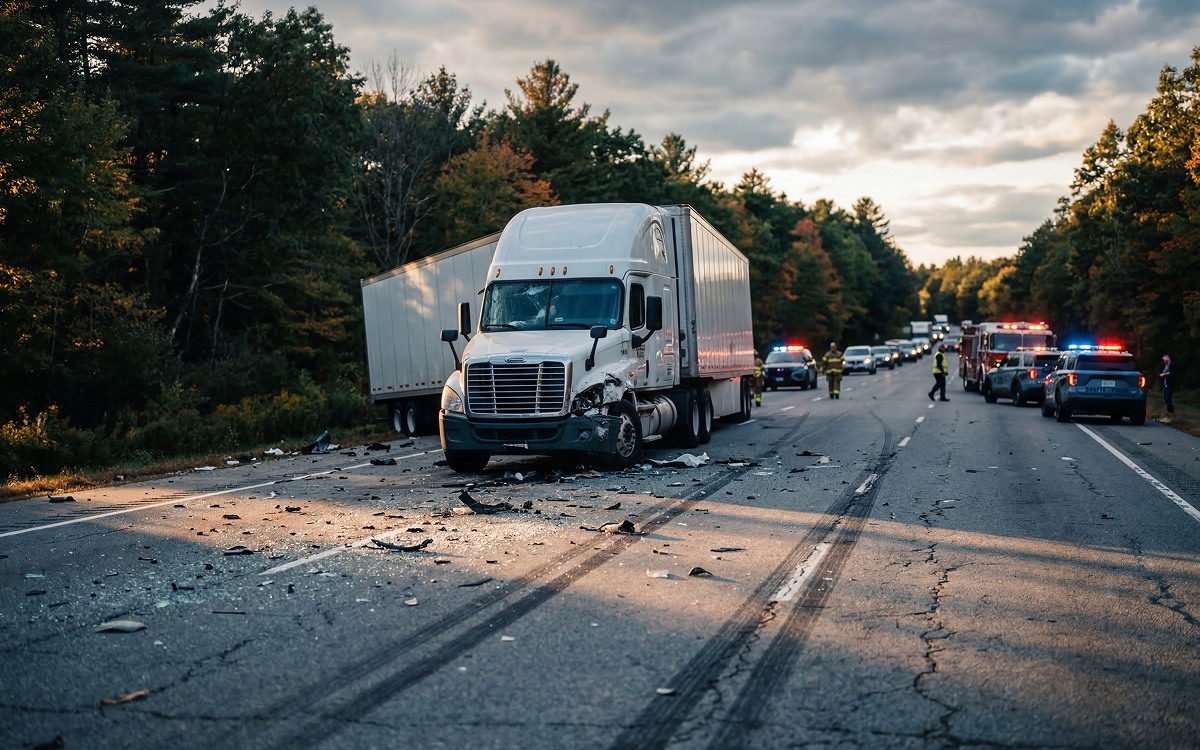
Truck accidents are among the most catastrophic events on Massachusetts roads. When a commercial vehicle collides with a passenger car, the consequences are rarely minor: the average fully loaded tractor-trailer weighs up to 80,000 pounds, roughly 20 times the weight of a standard sedan. The injuries are severe, the legal questions are complex, and the window to act is shorter than most victims realize.
This guide explains who can be held financially responsible after a truck accident in Framingham or anywhere in Massachusetts, and what deadlines you must meet to protect your right to compensation.
How Dangerous Are Truck Accidents in Massachusetts and Across the U.S.?
The numbers make a clear case for taking these crashes seriously.
According to the Federal Motor Carrier Safety Administration (FMCSA), large trucks were involved in 168,320 injury crashes across the United States in a single recent year , a figure that has trended upward over the past decade. Fatalities involving large trucks reached 5,936 nationwide, with occupants of passenger vehicles accounting for 72% of those deaths (FMCSA Large Truck and Bus Crash Facts).
In Massachusetts, the Executive Office of Public Safety and Security (EOPSS) and MassDOT track commercial vehicle crashes through the Highway Safety Division. Massachusetts consistently records hundreds of commercial vehicle crashes annually, with Interstate 90 (the Mass Pike), Route 9 through Framingham, and Route 495 among the most active commercial corridors in the state.
Middlesex County, where Framingham is located, is one of the most densely traveled counties in the Commonwealth, making it a high-risk zone for truck-involved collisions.
Who Can Be Held Liable for a Truck Accident in` Massachusetts?
Unlike a standard two-car crash, truck accident cases frequently involve multiple parties who each carry a share of legal and financial responsibility. Identifying every liable party is not a formality , it is the single most important factor in determining how much compensation a victim can recover.
The Truck Driver
The driver is the most immediate defendant. Massachusetts negligence law requires proving that the driver owed a duty of care, breached that duty, and that the breach caused your injuries. Common driver failures include:
- Violating FMCSA Hours-of-Service (HOS) regulations , federal rules that limit drivers to 11 hours of driving within a 14-hour on-duty window, with mandatory rest periods (49 CFR Part 395)
- Distracted driving, including mobile phone use prohibited under 49 CFR Part 392.82
- Driving under the influence of alcohol or controlled substances
- Speeding, improper lane changes, or failure to check blind spots
- Fatigued driving , a contributing factor in approximately 13% of large truck crashes, according to the FMCSA
It is worth noting that even when the driver is clearly at fault, they rarely carry personal assets sufficient to fully compensate a seriously injured victim. That is why the investigation must go further.
The Trucking Company
Under respondeat superior , a well-established principle of Massachusetts common law , an employer is vicariously liable for the negligent acts of an employee committed within the scope of employment. If the driver was working a route for the company at the time of the crash, the company shares liability automatically.
Beyond vicarious liability, the trucking company may be independently negligent for:
- Negligent hiring: Failing to verify a driver’s Commercial Driver’s License (CDL) status, safety record, or prior violations through the FMCSA Pre-Employment Screening Program (PSP)
- Negligent training: Inadequate instruction on cargo securement, defensive driving, or adverse weather operation
- Pressuring drivers to violate HOS rules to meet delivery deadlines , a practice the FMCSA has documented and penalized through its compliance review process
- Negligent supervision: Failing to monitor Electronic Logging Devices (ELDs), which have been federally mandated since December 2017 under 49 CFR Part 395
Direct negligence claims against the trucking company are particularly powerful in litigation because they can support a claim for punitive damages when conduct is found to be willful or grossly negligent.
The Truck Owner or Leasing Company
The company that employs the driver and the company that owns the truck are not always the same entity. Many fleets operate on lease arrangements. Under 49 CFR Part 376, when a motor carrier leases a truck, it assumes legal responsibility for the operation of that vehicle during the lease period. The owner or leasing company may also be independently liable for deficient maintenance.
The Cargo Loading Company
According to the FMCSA, improper cargo loading contributes to thousands of truck crashes annually. Cargo that is overloaded, unsecured, or unevenly distributed can shift in transit, destabilizing the truck and triggering a rollover or jackknife. Federal cargo securement standards are governed by 49 CFR Part 393, Subpart I.
If a third-party loading company was responsible for loading the truck, they may bear direct liability for any crash attributable to cargo failure.
The Truck Maintenance Company
Federal regulations require that commercial motor vehicles be systematically inspected, repaired, and maintained under 49 CFR Part 396. If a third-party maintenance contractor performed negligent work , or failed to identify and correct defects , and that failure contributed to the crash, they can be named as a defendant.
The Commercial Vehicle Safety Alliance (CVSA) reports that brake system violations are among the most cited defects in roadside inspections, found in a significant percentage of all commercial vehicles inspected annually.
The Truck or Parts Manufacturer
When a crash is caused by a mechanical defect rather than human error, product liability law applies. Massachusetts follows strict liability standards for defective products: under Haglund v. Philip Morris, Inc. and the broader framework derived from the Restatement (Second) of Torts § 402A, a manufacturer can be held liable if a product was defective and that defect caused harm , regardless of whether the manufacturer was negligent.
Common defect-related crash causes include:
- Brake system failures
- Tire defects or blowouts (tire-related factors appear in approximately 30% of large truck crashes per NHTSA data)
- Defective steering components
- Coupling system failures that allow trailers to detach
Government Entities
Road conditions maintained by MassDOT or a local municipality can contribute to truck crashes. Claims against government entities in Massachusetts are governed by the Massachusetts Tort Claims Act, M.G.L. c. 258, which requires a written presentment notice within two years of the incident , a shorter window than the standard statute of limitations, and one that is easy to miss without counsel.
How Long Do You Have to File a Truck Accident Lawsuit in Massachusetts?
This is where many victims lose their cases, not in court, but on the calendar.
What Is the Statute of Limitations for Truck Accidents in Massachusetts?
Under Massachusetts General Laws Chapter 260, § 2A, the statute of limitations for personal injury claims , including truck accident lawsuits , is three years from the date of the accident. Missing this deadline by even a single day means the court will dismiss your case permanently. No exceptions for severity of injury. No sympathy for hardship.
Are There Shorter Deadlines That Apply to Truck Accident Cases?
Yes , and this is critical.
Claims against government entities: If a MassDOT road defect or a municipality’s failure to maintain a road contributed to your accident, you must file a formal written presentment with that government entity within two years of the incident under M.G.L. c. 258, § 4. This is a prerequisite to filing a lawsuit , skip it and you lose your right to sue the government entirely, even if the three-year limitation period has not yet expired.
Wrongful death claims: If a loved one died in the truck accident, the personal representative of the estate has three years from the date of death to file a wrongful death action under M.G.L. c. 229, § 2.
Victims who are minors: When the injured party is under 18 at the time of the accident, the three-year clock does not begin until they turn 18 , giving them until age 21 to file. This exception is codified under M.G.L. c. 260, § 7.
Why Waiting, Even Within the Deadline, Can Destroy Your Case
The statute of limitations sets the outer legal boundary. It does not define the practical deadline for preserving evidence.
Electronic Control Module (ECM / “Black Box”) data: Commercial trucks are equipped with ECMs that record vehicle speed, braking force, throttle position, and other critical data at the time of a crash. This data is frequently overwritten within 30 to 60 days. Without a formal legal preservation demand (litigation hold) sent immediately, this evidence disappears.
Dashcam and surveillance footage: Retention policies for dashcam systems and nearby commercial security cameras typically range from 14 to 30 days. After that window, the footage is gone.
Driver logbooks and ELD records: Federal regulations require carriers to retain driver logs for only six months under 49 CFR Part 395.8(k). After that period, the company has no obligation to preserve them.
Witness memory degradation: Research on eyewitness memory consistently demonstrates that recall accuracy declines significantly within weeks of an event. First accounts, taken promptly, are far more reliable and credible in litigation.
Post-accident truck repairs: Without a preservation demand, the trucking company can legally repair or replace the truck, eliminating physical evidence of mechanical defect or pre-existing damage.
The practical lesson: the three-year deadline is the last possible moment, not the right moment. The right moment is immediately.
What Should You Do Immediately After a Truck Accident in Massachusetts?
- Seek emergency medical care , even if you feel uninjured. Many serious injuries, including traumatic brain injury and internal bleeding, are not immediately symptomatic.
- Document the scene , photograph the vehicles, road conditions, signage, skid marks, and cargo if possible.
- Get the truck’s DOT number and carrier information , displayed on the cab door of every commercial vehicle under federal law.
- Do not give a recorded statement to the trucking company’s insurer without legal counsel.
- Contact an attorney immediately , to issue a litigation hold, preserve ECM data, and identify all potentially liable parties before evidence is lost.
FAQ: Common Questions About Truck Accident Cases in Massachusetts
What is the statute of limitations for a truck accident lawsuit in Massachusetts? Three years from the date of the accident under M.G.L. c. 260, § 2A. For claims against a government entity, a presentment must be filed within two years under M.G.L. c. 258, § 4.
Can I sue the trucking company even if the driver caused the accident? Yes. Under the respondeat superior doctrine, the trucking company is automatically liable for a driver’s negligence committed within the scope of employment. The company may also face independent liability for negligent hiring, training, or supervision.
What if the truck driver was an independent contractor? Trucking companies often misclassify drivers as independent contractors to avoid liability. Massachusetts courts look past this classification when the company exercises meaningful control over the driver’s work. An attorney can evaluate whether the independent contractor designation will hold up in your case.
How much is a truck accident case worth in Massachusetts? Case value depends on the severity of injuries, liability factors, available insurance coverage, and whether punitive damages apply. Commercial trucking policies are federally mandated to carry a minimum of $750,000 in liability coverage under 49 CFR Part 387, with many carriers carrying $1 million or more. Serious injury cases often involve multiple defendants and multiple policies.
What evidence is most important in a truck accident case? The truck’s Electronic Control Module (ECM/black box) data, driver logs and ELD records, post-accident inspection reports, the carrier’s safety record with the FMCSA, cargo loading manifests, maintenance records, dashcam footage, and witness statements.
What if I was partially at fault for the truck accident? Massachusetts follows a modified comparative negligence rule under M.G.L. c. 231, § 85. You can still recover damages as long as your share of fault is 50% or less. Your compensation is reduced proportionally by your percentage of fault.
How long does a truck accident case take to resolve in Massachusetts? Cases that settle through insurance negotiations may resolve in several months. Cases that proceed to litigation typically take one to three years, depending on complexity. The involvement of multiple defendants and federal regulatory issues makes truck accident cases more complex than standard car accident claims.
Do I need a lawyer for a truck accident claim in Massachusetts? Truck accident cases involve federal regulations, multiple potential defendants, aggressive insurance defense teams, and tight evidence-preservation deadlines. Attempting to navigate this without legal representation significantly reduces both the likelihood of success and the value of any recovery.
What if the truck driver fled the scene? A hit-and-run involving a commercial truck may still allow recovery through your own uninsured motorist coverage under Massachusetts law, and law enforcement investigation may identify the carrier through the truck’s DOT number, partial plate, or surveillance footage.
Can I file a truck accident claim if the accident happened on Route 9 or the Mass Pike in Framingham? Yes. Framingham is within Middlesex County, and Foglia & Associates handles truck accident cases throughout Massachusetts, including crashes on Route 9, I-90, Route 30, and Route 135.
If you were injured in a truck accident in Framingham or anywhere in Massachusetts, contact Foglia & Associates at (508) 820-3400. Attorney Michael Foglia and Attorney Radu Brestyan, a former Middlesex County Assistant District Attorney, will evaluate your case and ensure every deadline is met and every liable party is identified.
Sources cited: FMCSA Large Truck and Bus Crash Facts (2022); 49 CFR Parts 376, 392, 393, 395, 396, 387; M.G.L. c. 258, § 4; M.G.L. c. 260, §§ 2A, 7; M.G.L. c. 229, § 2; M.G.L. c. 231, § 85; NHTSA Traffic Safety Facts; Massachusetts Tort Claims Act; Restatement (Second) of Torts § 402A.